Showing posts with label India. Show all posts

Friday, June 25, 2010

Cricket, Anyone?

India SaharaSo are you watching the World Cup? Speaking of sports that Americans rarely watch and haven't a clue about . . . seen any good cricket matches lately?

If you're on this side of the Atlantic you're probably thinking, "Heh, yea--don't try to con me, I know no one actually plays cricket. It's just a myth. Kind of like Big Foot or the Yeti or something like that."

But no--I'm serious. Cricket is a very big deal in India. VERY big deal. So big that the place practically shuts down when they play their arch-rival, Pakistan.

In fact, forget Lakers-Celtics face-offs, forget legendary USSR-USA Olympic battles, in sports it is the India-Pakistan competition that gets the title of Most Ferocious Rivalry in all of sports. Hundreds of millions of viewers tune in when the two teams get together, making our Super Bowl look like Pee Wee football by comparison (with its mere 90 million spectators).

In fact, I suppose that if you were to sit both countries down and tell them that the world had voted and that whole pesky Kashmir issue was going to be decided by one big old cricket game I bet you 50 million rupees that both countries would agree.

Probably because cricket games can last longer than most wars. By the time the match would be wrapped up and officially called the Kashmir region might actually have eroded into a vast uninhabitable desert. In "first class" cricket games are played for three to five days with six hours of play each day but in "test match" cricket games are scheduled for five days and can run much longer--some as long as ten days. The fans would have to be loyal to deal with that kind of suspense.

I wonder . . . if you had tickets to a match would your seats qualify you to see all days of play or are tickets for one day only? Because that would truly stink.

While we were there in March we wanted to bring back something for each of our four children. The girls were easy, the marketplaces are filled with shiny and sparkly things, flowing fabrics and everything a girl would want to feel pretty but a boy? Something told me that they wouldn't appreciate an authentic dhoti or kurga.

Sahara IndiaThe last day we were in Bangalore I was passing a shop that sold cricket gear and it hit me--sports have a way of crossing cultural boundaries and something told me that my two rabid sports fan would find cricket gear very, very cool.

David got an authentic cricket bat from my mother and we completed the set with a cricket ball (looks much like a croquet ball and is hard as a canon ball. Did I mention they catch barehanded? I cringe just thinking of it) and Spencer got a cricket jersey like you see above.

It made me feel kind of funny though--you can't walk through a mall here without seeing hundreds of kids all advertising their favorite team but when we asked how much the cricket shirt cost we were told, "Three hundred, fifty rupees--but most kids can't afford them at that price."

Three hundred and fifty rupees. That's about seven dollars and the average Indian kid can only dream of owning one. How many dollars are spent on overpriced sports memorabilia and a seven-dollar cricket shirt is too expensive? As I plopped down the cash and collected our purchase I felt a twinge of shame at being able to provide something for my child that millions of Indian kids would never be able to have--and would my child even appreciate it as much as his Indian counterparts?

So we bought it and then I worried--worried that we'd pull it out of the suitcase and he wouldn't like it. He's somewhat particular in his clothing tastes and I could see him thinking that none of the other kids at school were wearing cricket jerseys which meant they were uncool and non-wearable. I could see it happening. I worried that he wouldn't like his present and worried that it would be even more embarrassing to bring him something that children on the other side of the world would die for but he was too spoiled to appreciate.

The morning after we returned from our trip we had the great "opening of the suitcases" ceremony where the kids gathered around in anticipation. They knew that we'd brought them each back a little treat and one by one the gifts came out until the cricket shirt was the last thing unseen.

"Now I hope you like this," I started to say as I reached to the bottom where the shirt lay hidden, "In India this is very, very cool--it's kind of the equivalent of having a Chargers jersey if you lived in India. Kind of. Only much more cool. Did I mention this is cool?"

I handed him the shirt and . . . he loved it. His face said it all but any lingering doubts as to his feelings have since been thoroughly eliminated because each week I have to hunt him down, peel it off of his body and demand that he put it in the wash. For health and safety's sake if not for personal hygiene.

Yes, he loves his jersey and now he'd even like to catch a cricket match--or at least the first day of one. Sports really are the universal language.


P.S. I don't think they needed to stage this commercial--that street looks completely authentic. They probably just showed up at 7pm with a film crew and *presto* everything was ready to go.

Sponsored by Storkie.com for baby birth announcements

Sunday, June 13, 2010

Sweet (or Salty) Lime Sodas

Sweet Lime SodasPerhaps the best thing I came back with from our trip to India was a deep, abiding love for lime sodas.

You can't drink the water but who cares?? When you've got a drink as tasty and fantabulous as lime sodas forget the water, you'll be drinking these forever after.

You see here Andrew and I partaking of sweet lime sodas at the pool in Hyderabad and the beauty of these drinks is that they are built to fit your mood because you can have lime sodas two ways: sweet or salty.

I know, I know--a salty soda may sound suspicious but I promise you that they're good. The lime soda is great sweet but when it's salty you get a little kick that is different but pleasantly so.

So if, for your summer picnics, you'd like to be very popular then consider making up the drink and see how your guests rave. You can make them as is and have them salty or drop the salt and increase the sugar. I'd also think that using a touch of ginger and honey in place of sugar and cumin would be very good.

This makes enough for one 12-ounce glass.

Juice of 2 limes
3 tsp sugar
Pinch of salt
Pinch of freshly ground cumin
12 ounces soda water, chilled
Ice (optional)

Pour the lime juice into a chilled glass, and add the sugar, and then the salt and cumin to taste.

Add ice if you like, top up with chilled soda water and serve immediately, garnished with lime wedges.

Sponsored by Dimples and Dandelions for Serena and Lily baby bedding.

Friday, June 11, 2010

Mind if I Stare?

IndiaWhen we went to India in March I wasn't prepared to be one of the only two tourists in the country. I hear that most tourists go to the only part of India of which they're aware (i.e. the Taj Mahal and Dehli, maybe Mombai in a pinch) but we were in the south on the tip of the subcontinent where we could go days without seeing any other pale faces.

So it's not hard to understand why we were a subject of curiosity. According to my mother and father Indians are naturally curious people and will gather around any odd occurrence like kids around an ice cream truck. Though personally, I wondered if it wasn't so much that they are more curious than other people as that in India it's not considered rude to stare.

I, myself, am curious about anything strange but I've always been told it's impolite to stare so I'd be too embarrassed to join in the crowd. In India, however, it's perfectly fine to stare and let me tell you they take full advantage of the liberty (which I have to kind of envy if I were to be honest--sometimes staring is much more fun than pretending that one sees fully tattooed and mohawked women with piercings dangling from their eyelids every day).

So as if I didn't stand out enough being so pale and pasty (thanks, Alaskan sunshine) being six feet tall and blonde didn't help me blend in any. In the south people are frequently darker and shorter than you might find in the north (speaking in large, general terms) so I stood out like . . . like . . . like a crazy tall blonde woman in sunglasses (no one wears sunglasses there).

Everywhere we went people stared and gaped and rubbernecked and if they were particularly brave (which they usually were) they'd come up and ask if they could take my picture.

Not wanting to be rude I'd happily give them permission but as soon as one person got the go ahead it opened the flood gates for everyone else in the perimeter to jump in and do the same. It would start with one person then another and then another until I felt like Jennifer Aniston with a crowd of paparazzi--only taller and completely less glamorous and well-paid.

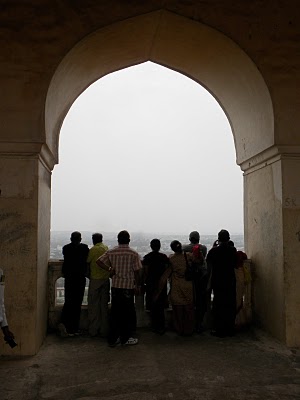
The day we went to Golkonda fort we arrived at the top of the fort where I was met by a man and his friends who waved a camera at me and asked if he could take my picture (see the picture at the top). I nodded and stood back against the wall where he began to snap away. His friends pulled out their cameras and joined in and then as more people came up the stairs they too began taking my picture until I was surrounded by twenty or so people--mostly men--taking pictures to most likely email to all their friends around the world with a text message that probably went something like: "Get a load of the bizarre thing I saw today--you'll never guess. . . ."

Usually they'd assume we were British or Australian but as soon as we said we were from America they'd smile and nod their head and say, "Oh, U.S.!"

I guess it's only fair that if I come to their country and spend my time walking around with my mouth open in amazement that they can do the same to me, right?

Sponsored by Polkadot Peacock for children's bedding.

Friday, June 04, 2010

Poverty in India

When I was young I knew some people who went to India and came back with stories of how shocking the poverty was. Carts to collect the dead making their rounds every morning, beggars flooding the streets--the way they described it made an indelible mental image and I knew I never wanted to go to such a terrifying place.

So traveling there in March I was particularly curious about what I would experience. Would it be so bad as the stereotypes? I'd been to poor countries before and seen dead rats and tattered children together in the streets but how would India compare?

Poverty in India
As missionaries, my parents live there in under rather unusual circumstances--because of the political history of Christianity they are prohibited from giving money to beggars. Too many times have churches been guilty of buying converts so that as missionaries, if they were seen to give even a small amount to beggars, it would jeopardize religious and political relations. As guests of my parents I had assumed that we'd be under the same restrictions.

The first day in Bangalore I saw no beggars and it wasn't until the next day as we were leaving Mahabalipuram that I saw her. An old woman squatting on the pavement against a fence, her knees bent up around her chest and her arms resting limply on the ground near her bare feet. Her white sari, while still beautiful around her straggling silver hair, was dirty and obviously of an inferior quality and she had none of the typical gold jewelry most Indian women wear.

As we passed by her she raised her left arm, her hand cupped, and called something. As my shadow moved over her I looked down and noticed that inside her wrinkled face and sunken lips her eyes shown white and dead against her dark skin, matching the white of her sari and standing out all the more starkly because of it.

The cataracts were so thick across her eyes she probably couldn't see me but I saw her and, not wanting to be rude, I tried not to stare. I'd seen homeless people in America holding their cardboard signs at intersections, asking for work or help, but I'd never seen someone so pitiful as this. Probably someone's mother or grandmother, I wondered what had brought her to sit there, waiting for tourists to pass by and share a few coins on their way to the souvenir vendors a few yards away.

I wanted to help her but felt powerless to know what to do. Afraid to give her any money for fear of causing problems for my parents, I did nothing and crossed to the other side of the sidewalk to wait while Andrew bought a green coconut to drink.

Later on in the trip we were driving through Bangalore. Stopped in traffic and waiting for our turn to inch through the intersection, the car sat there in the sun as a man approached the car. He loomed up suddenly on my left and stuck out his arm against the window. Where a healthy arm should have been there was a withered and deformed limb that looked as little like an arm as a sapling that has been burned by the sun and wind looks like a tree.

I was shocked and wasn't sure what to do. He thrust his arm toward me and said something--I'm sure I don't remember anything that resembled English--and it was clear what he wanted. It was one of those situations where things kind of froze and the horror of what I was seeing clogged up my brain.

Suddenly the traffic began to inch forward and as our turn to move came my mother said, "It's alright if you want to give him something."

"But I thought you weren't allow to give money to beggars," I said.

"We're not--but it's okay if you want to do something,"

As I turned over this new information the car moved and we were gone, the man was left standing in the intersection to wait for the next car and I felt a new emotion--realizing that I could have given something to help this man or the woman with cataracts but that I'd missed my chance. Secretly I pledged that the next time this happened I wouldn't let the moment slip by so carelessly. Next time I'd be prepared and it wasn't too long before I was given a chance.

At another intersection we were again waiting for traffic to move and I sat there, watching the hordes of people moving all around us. As always, we rode with Sampath driving us in the Ford SUV that belonged to the missionary office there in Bangalore and which was a glaring symbol of luxury and money in a town filled with rickshaws and ox carts. While it had tinted windows I soon figured out that the windows weren't as private as I initially thought--too many times I'd seen people wave at me or stare as we drove by to think that I was as hidden as I felt and now, stopped in traffic, a child came up to the car and made her way directly to the window where Andrew was sitting.

About Lillian's age, with chin-length hair, big brown eyes and a dirty face, she held out her hand and began her begging by slapping on the window to show her desperation. When I realized what she was doing all my mother-ness rose up and, remembering my new pledge, I said to Andrew, "Give her something," and I reached into my purse to pull out some rupees.

I passed him a ten rupee note (about 20 cents U.S.) and he rolled down the window to give it to the little girl. The moment his window was cracked and the rupees were on their way toward her hand there was this palpable change. She nearly jumped inside the car to grab at the money and at that moment several other children swarmed out of nowhere around her to make a grab for the bill themselves. Never taking her eyes from the piece of paper, the second it got close enough she snatched at it and, so quickly you could hardly follow the motion with your eyes, she folded the money into her chest and it disappeared. Then she turned and ran away before the other children seemed to realize she was gone.

The rest of them tried their hand at getting more money but the scene reminded me a bit of some of the nature shows I'd seen where one moment the sweet little chimpanzees are playing happily in the woods together and the next they've turned on one another, tearing each other to bits. It was startling and disturbing and I realized that this was a child who'd lived her life by begging. She was a professional and she was good at it and she would take those 10 rupees home as her portion of the earnings for the day.

Talking with Mom she said that there have been plenty of times when she'd seen children begging or mothers with babies begging and so often she'd ache to help them and want to give them money but then as she came to know the country better she learned that it's not uncommon for families--particularly families from the rural areas outside the city--to come in to beg every day as the family business. It's not unheard of for babies to be used as props for theatrical value, even drugging them for added drama, and just as in America, it can be hard to know who is truly in need and who is just trying to make their living from the pity of strangers.

It was all a very strange experience. To first feel that I'd missed my chance to be kind and then, when again offered a chance, to realize I'd most likely been scammed was all startling and uncomfortable.

So to answer my original questions: Are there beggars in India? The answer is: Oh my yes. Lots of them. Are there people dying in the streets? Maybe--I didn't see any but then I stayed in a lot of the more affluent areas.

But while I may know the answers to those questions I still have the same questions I have whenever I see people suffering in my own back yard, namely: How do I know who is really in need and how can I best help them?

Perhaps it's just a matter of doing those little things whenever you have the chance and letting the Lord sort out the details of whether it was needed or not.

Sponsored by Polkadot Peacock for children's bedding.

Friday, May 21, 2010

Traveling in Luxury

Hey! (Or should I say "Hay")?

Look carefully. We were following this truck leaving Bangalore when we noticed a man taking a nap on top. He was jiggling back and forth with each bump and I was sure the whole pile would shift and send him over the side but he appeared not to notice my concern.

Pictures of India
Luckily Dad had his camera at the ready.

You'll see everything in the world piled on trucks in India--and usually overloaded to the point that you can't understand how it was piled so precariously. The cargo may be as simple as hay or it may be a more human commodity.

Pictures of India
All the trucks are overloaded and all the trucks have bald tires. No tire is so worn that it can't be passed on and reused on another vehicle. It makes you wonder if anyone bothers to actually buy new tires or if the whole country just rotates the same sets of wheels from car to car ad infinitum.

Pictures of India
Great pictures Dad.

Sponsored by findyourschool.com--Find the perfect school in your area.

Friday, May 14, 2010

Mystic White Sri Lankan Sea Turtles

Now there's a title to get your attention. Sounds like a great name for a rock group, doesn't it? While Andrew and I didn't get as far south as Sri Lanka when we visited India in March my parents visit the island regularly and during one of their visits they saw this:

Albino Turtle Isn't it beautiful and interesting and creepy all at the same time? The sea turtle was being held at a turtle conservation site south of Colombo because it wouldn't survive in the wild without its color to camouflage it from predators. Guess what the Sri Lankans named the turtle? Just guess.

"Michael Jackson." Yes, I speak the truth. They're HUGE Michael Jackson fans in that area of the world. Cried for days at his demise.

Sea Turtle
Apparently they started the center to preserve the turtles because locals would eat the eggs, depleting the population. So they started paying people to turn in the eggs instead (10 rupees an egg Mom thought, or about 2 cents) and then they "plant" the eggs in rows along the beach with little row markers showing the time of planting. Then twenty-eightdays later the eggs hatch and they release the babies at night to protect them against predators flocking to the free buffet.

Sea Turtles in Sri Lanka
The eggs are like perfect little ping pong balls only leathery and they're heavy because they're full of liquid (and baby turtle obviously). But I digress . . . could it get any cuter? It's like this post was sponsored by Precious Moments. These are pictures my Dad took and here's Mom holding her very own sea turtle. Makes me wish we'd got down to Sri Lanka.

Sponsored by Storkie.com for baby birth announcements.

Friday, May 07, 2010

Saris and Other Indian Fashions

Another post about India? Yup. It's a hard place to shake I tell you. I've had people ask if I bought myself a sari and the answer is no. Though who wouldn't feel that much classier pushing her cart through Walmart while wearing one of these??

Indian SarisActually, these are some of the fanciest saris in a high-end boutique on Commercial Street in Bangalore. Because all of the gorgeous colors and fabrics may look the same to untrained western eyes, there are some things you may not know. . . . These particular saris have a close-fitting top called a choli and the skirt is a ghagra, then there is a scarf that goes over the whole ensemble that allows you to see the decorative beadwork beneath.

Indian Saris
This, however, is a sari in the more wrapped-body sense. Apparently (as my good friend Jane Hamilton educated me) the sari was born in the southern-most state of Tamil Nadu where she lives and we traveled. You can see the choli underneath but the ghagra skirt is hidden by about 9 yards of silk. In this version it's an underskirt with a draw-string waist that is more like a heavy slip than a skirt.

We'll get back to that in a moment. . . .

Indian ChudidarHere is Lillian in her chudidar (just because I won't wear Indian gear in public doesn't mean my kids can't--it's the beauty of being seven) which is another traditional Indian outfit. In the south we saw saris and chudidars, chudidars and saris with only one or two women wearing jeans.

The chudidars are made of a long overshirt, usually with slits on both sides, and a pair of pants that are made so long they bunch at the ankles. Then a jaunty scarf tops off the ensemble. Lily was quite the international queen when she wore this to church with her purse from Thailand, her shoes from China and none of them the same color.

Indian WomenMy father took the rest of these photos and they give you an idea of the variety of dress you'll see. I think these women are from the northern part--I'd guess Jaipur?--where the climate is a little cooler and the influences from Afghanistan and Pakistan are evident.

Indian SariBut you'll see saris everywhere. And the answer is YES, all that fabric is terribly hot. You get the impression from all the breezy, flowing fabrics that they're a cool fashion option in 100 degree weather but that would be incorrect. As my mother wrapped me up in her sari every layer of fabric was more and more stifling until I wondered how they can stand it. Indian women are amazing.

Indian SarisIf they're working they'll just scoop up the back hem of the sari and stuff it in at their waist so that it comes up between their legs and makes a sort of Gandhi-style set of shorts. Functional but still very warm.

Indian Saris
But going back to my own experience, what I found interesting was that I had the mistaken impression that you just wrap up your sari and go (shows how much I know) but just as with western fashions where women know exactly what cuts of blouses are in and which are not, how long stylish jeans need to be and the most vogue ways of wearing a scarf there are definite trends and fashions in wearing saris.

Indian SarisYou see how baggy the choli shirt is on my arms? Very tacky. Indian women wear their cholis as form-fitting shirts and they'll often wear them so tight around the arm that I wonder how they get them on and off. Fashion mistake number one.

Then you can't see it but my choli goes to my waist. Usually cholis stop just below the bustline, leaving your stomach bare (and let me tell you I saw a lot of stomachs in India--it was comforting to see how many other women have the same sagging, post-pregnancy battle scars I do. It was rather liberating). But when my mother had this sari made for her, not wishing to show off her own stomach, she asked them to cut it long. They informed her that only nuns wear them that way which made both of us chuckle. Fashion mistake number two.

And as for the actual wrapping process it's terribly complex. You knot one corner of the fabric, tuck it in the right side of the drawstring waist of your underskirt then wrap it to the left around you. After two wraps you reach for the other end of all that fabric and pleat it. Then you wrap that pleated end around the back, over your chest and over your left shoulder. Very tricky.

But the hardest part is yet to come because you still have yards of fabric in the middle unaccounted for. You pick up that section right at your waist and in this tricky rocking motion with your outspread hand you gather up the extra fabric in about ten eight-inch pleats which you tuck into your waistband as a group. Ready to go!

The process took us about 20 minutes for that photo of me though the woman in this video clip does it in a minute. However, there are professional sari wrappers whom you can hire if you have a special occasion--such as your wedding day--where you want your sari to be absolutely perfect and cutting-edge fashionable. I don't think I'll be applying for that job anytime soon.

Sponsored by Polkadot Peacock for children's bedding.

Friday, April 30, 2010

The Most Expensive House in the World

World's Most Expensive HomeSpeaking of the subject of narcissism (as it seems I have for a couple weeks now) how about this one?

Mukesh Ambani is the world's fifth richest man, worth approximately $43 billion dollars, and he's building the world's first billion-dollar home. Actually, those interested in trying to strip him of the title and "keeping up with the Guptas" will have to go farther than that because as it's under construction in Mombai, the home is actually worth close to $2 billion dollars (so far) and is a towering tribute to uh . . . to uh . . . money? Ambition? Industry? I'm not sure, all I know is that for your dollar this home is the ugliest thing per square foot that I've ever seen. And I know, I've seen some ugly homes in my time.

It looks like they took a bunch of stands from Wrigley field, stacked them on top of each other then added a LOT of plants without the benefit of actually getting to see the Cubs play.

Ambani is the son of the founder of Reliance Industries, the biggest company in India, and I suppose it would be like Bill Gates' son deciding to build a skyscraper in Seattle for his family. Besides the yoga study, swimming pool and four-story, open-air gardens the home boasts an ice room where you can beat the Mombai heat with man-made snow flurries. Nice.

I've heard (Dad told me about this while we were in India) that he's going to be housing 17-20 of his relatives so he really needs the extra space. Apparently the home where the family with their three children are currently struggling to get by is a 22-floor tower in downtown Mombai that they've remodeled to fit their needs but just can't seem to make work.

I don't know . . . everyone has their weaknesses and I guess mine isn't big homes (it's donuts). I don't like walking into a home and feeling small, instead I want to feel comfortable and something tells me this isn't a relaxing place to hang out. Not with marble bleachers, gold and 17-20 of your closest relatives--but then maybe that's why they've got the yoga studio included.

Ohmmmmmm. . . .

Sponsored by Overstock.com for free online coupons.

Friday, April 16, 2010

Art from India

My mother, Sharon Nichols, gave me copies of two of her many sketches she's done while living in India. This first is a drawing of the sultan Tipu's summer palace in Bangalore.Tipu's Summer Palace in BangaloreThis second is of the city of Goa on the west coast which used to be a Portuguese colony but now attracts a lot of European tourists. I'm going to get some bright, colorful mats and black frames and hang them next to a grouping of photos from the trip. Aren't they just beautiful?

GoaThen, branching out a bit, this is a mural from Tipu's winter palace in Mysore. It shows a battle against the British and it reminds me rather of the Bayeux tapestry. It has the cavalry charging, a few beheadings here and there, elephants charging and arrows flying which makes you feel you're part of the noise and chaos of battle.

Mural at Tipu's Winter Palace
This is a picture my father, Mel Nichols, took of some sand art. Hindus will use the sand--or colored rice flour--to draw intricate designs and when they do it in front of their doorstep it's supposed to bring good luck. They have this careful way of holding the powder so that it drops perfectly from their fingers in an even stream and each morning when we left the apartment in the morning Mom and Dad's neighbor had a different little design on the cement in front of her door.

Hindu Sand Art
But in India art is everywhere, it's just a part of life which may seem strange in a country that has a reputation for poverty and chaos but if you think about it it makes sense--art makes life a little more bearable and with so many people in India you have that many more minds thinking creatively. What else would you expect from the land of peacocks? Even their wildlife is decorative.

Peacocks in India
Where else would you see four conjoined man-elephants in gold on top of a building? (And there is so much of this kind of thing you stop taking pictures of it after a while).

Ganesh in India
Or doors decorated with such intricacy?

Golkonda Fort, India
Seems as if everyone was busy making something pretty. Even in dusty alleyways like this one where this man was beading a silk sari.

Man Beading a Sari
It's just a beautiful place.

Sponsored by Dimples and Dandelions for Serena and Lily baby bedding.

Wednesday, April 07, 2010

Silk Worms throughout the House

Remember how we visited the silk worm auction outside of Bangalore? Well it was one of my favorite things to see on our trip because it was so interesting. The farmers brought in bags and bags of silk worms in their silk cocoons.

Silk Worms
Here is one cocoon that they cut open for us to see--the little worm is still wriggling around. The little piece of dirt that's stuck to his head is his waste.

At the silk worm auction there were two separate kinds of silk worms: the whiter, smaller cocoons are the Chinese variety (see the cocoon on the left) and the larger, yellower cocoons are the Indian variety (see the cocoon on the right). The Chinese are worth more because not only are they valued for their lack of color but because there is more silk--the Indian cocoons have about 800-1000 meters of silk wrapped around and around in one continuous strand and the Chinese have up to 1600 meters. The yellow cocoon looks as if it has more silk but for some reason the smaller Chinese cocoon is just packed more tightly.

Silk Worms
The farmers gave me several cocoons as souvenirs and they're about my favorite thing that I brought home from the trip (but then I've always had a weakness for natural souvenirs like pine cones and acorns and sea shells). They're rather sticky--almost like Velcro--as their strands cling to each other but they're also slightly shimmery. It kind of makes you wonder who it was that first had the idea to take one of these guys and harvest its tiny piece of string.

Two of the cocoons I froze overnight in the freezer to kill the little worms. I know it's brutal but they were doomed anyway and I figured it was kinder than letting them hatch in a frigid Arctic environment. Once they're sold at auction they're thrown into vats of hot water where the secretions that hold the strands in place are loosened and the individual thread of silk can be gathered and wrapped up for use.

Another cocoon we cut open to show the kids what was inside. By that time the little worm was half-way metamorphosed into a moth which is what you see in the picture above. I'm afraid he didn't make it either.

One little cocoon went with Lillian to show and tell at school and then the last cocoon I stuck in a bowl and left on my bedroom shelf just to see what would happen. When I got up Monday morning this is what I saw:

Silk Worms
It's wings were still wet and eventually dripped spots of tan color all over the bowl as they dried but we now have one bona fide silk moth in the house.

I'm not sure what to do with him, the chances of survival in an Alaskan April are pretty slim--we don't have too many mulberry trees up here--but I can't bear to kill it so I stuck it in a butterfly cage with a dish of sugar water to see if we could get it to eat but so far it's just sat on its cocoon and cried. I think it misses India too.

Sponsored by Dimples and Dandelions for Serena and Lily baby bedding.

Saturday, April 03, 2010

Back Home Again

Indian PeopleThis is my last post about our trip—we made it home safely and are walking around feeling very tired and very quiet after all we’ve seen and done—and while I could probably write for another month about everything we’ve seen and touched and smelled I won’t subject you to it, I promise. Instead I'll leave with just one more post and some of my favorite pictures that my father took.

My parents wisely told me it is easy for Americans to be consumed with the shocking things about India—trash in cities, pollution in the rivers, smells of agriculture and beggars in the streets—and miss the beauty. So I came with an open mind, aware that India might be the exact opposite of the life I’ve been used to but looking for whatever it was that made her unique.

I'm probably biased after such a trip but I think India is the most exciting place in the world. If there is a spot on the earth that is the exact opposite of Alaska it must be India and nowhere is the parallel of old and new so apparent and so hopeful. If India were a person, she would be a young girl in that preteen era before she becomes self-conscious—finding joy in everything and smiling with ease for the camera but she could also be an old woman who, while full of history, is still healthy and agile enough to be convinced that her best years are ahead of her.

Indian People
The sounds of India are of cars constantly honking and motors revving. Everything is under construction—partly from original shoddy workmanship that now requires repairs and partly from a constant stream of government projects waiting to be completed. Everywhere you hear hammers driving nails and jack hammers breaking up concrete and brooms sweeping.

Indian People
The languages are full of melody and cadence, rolling the Rs’ and clipping the D’s as if they were weaving some lacy pattern in and out with their words and while they sound foreign there is also this underlying familiarity that reminds that we came from the same roots, English and Hindu.

Indian People
But my favorite sound in all our time there was the Muslim call to prayer at morning, noon and evening when the mosques would send voices floating on the breezes over the traffic and smog of the city, calling the people to remember God.

Indian People
The colors of India are startling and bold, with flowers, silks and fruits. With statues draped in flower garlands and foreheads dotted by jewels and red powders. You see beauty in laundry fluttering on clotheslines, in blue houses with orange trim and green doors and even in the patchwork color of scattered trash in alleyways and vacant lots and blue tarps set up as permanent bivouacs in crowded campgrounds throughout the city.

Indian People
India is the world’s largest consumer of gold and women wear their jewelry as their dowry and the only possession that is completely theirs. They love the yellowest tones of the 23 carat gold and the voluptuous contrast of a round golden earring dangling seductively from a woman’s ear against the warm brown richness of her neck has no equal in the west.

Indian People
You could focus on the smell of decay that haunts any area lucky enough to have water or the sewers running under the sidewalks where the cracked granite slabs have broken up in places, allowing the reek to float up from beneath your feet but if so you’ll miss the strands of tiny white jasmine hanging from the women’s hair. You'd miss the spices and herbs piled on trays in the marketplaces, the smell of red clay bricks baking in the sun or livestock wandering through the city to nibble on garbage and stray blades of grass pushing up through cracks in the cement.

Indian PeopleYou might see the beggars wandering through traffic standing at stop lights, tapping on car windows and asking for money while holding up a baby they probably borrowed as a prop but then you’d miss the curving, twisting spires of temples rising on every city block and the cubist glass compounds of the tech trade where new jobs are sending more and more people to universities and toward life in the middle class.

There is no cigarette smoke but the smoke of outdoor cooking fires throughout the city takes the place of modern ovens. As a solution to trash removal you'll see piles of burning garbage here and there throughout the city--some with flames leaping waist high and some that are now smoldering. You’d think that in such a dry heat all of India would catch fire but the cities are made of so much brick and cement that no one worries about the danger and everywhere you'll see charred and blackened sections of soil bordered by cement.

Indian PeopleAfter all this America seems very boring to me. I will miss the way Indians bobble their heads in a gesture that can mean “yes,” “no,” “maybe” or “I don’t know” depending on context and mood. Mom says to do it you draw a figure eight with your nose and it’s such a joyful little move it makes me smile every time.

I’ll miss the modesty of Indian women. We saw no more than twenty western faces the whole vacation and I grew used to how elegant and feminine Indian women looked in their saris. When we arrived back at the airport to see mini skirts and tank tops once again I couldn’t help feeling how vulgarly the European and American women displayed themselves in what was essentially someone else’s home. I was embarrassed for them and understood a little better how the western values of promiscuity and immodesty can offend other cultures.

Indian PeopleBut it's strange that even with discovering this new love for a land so far away I still feel a thrill when I once again touched down on American soil. It may not be as colorful--Alaska has two colors: green and white--or as much of a feast for the senses but it’s a good place. Reliable, solid and strong and I love it because it’s my home. America will always be my native place but there will also always be a special place in my memories for India and someday I hope to go back.

Sponsored by Annette Lyon, whose new novel Band of Sisters is now in print.

Friday, April 02, 2010

Health Care, Schmealth Care. Take a Look at India and Covet

Chowmahalla Palace, HyderabadI’m not sure how to tactfully write this but I’ll give it my best shot. When we told people we would be traveling in India one of the comments I heard was “But you’ll get sick!”

And truthfully, I was rather nervous that I’d spend my vacation with two weeks of Delhi Belly but was assured by my mother that she would, once again, take care of me and save me from picking up any nasty treats. I guess you’d say she’d have my back (side). (Pardon my humor). She assured me that Americans really could travel to India very comfortably and never encounter any bouts of the dreaded dysentery.

India isn’t particularly special when it comes to the “don’t drink the water” policy—in most countries outside of the U.S., Canada and Europe it’s not safe to drink the water. Even in industrialized places such as Hong Kong and Taiwan it’s not a good idea to drink tap water and you should be careful with bottled water because it’s not uncommon for the water to be bottled straight from the local tap then sold as “safe.”

My parents’ apartment building claimed to have purified water but my Mom had her own water purifier in the kitchen just in case and all of our water came from that. Most of the hotels we stayed at—Sheratons and such—claimed to have safe water but I was extra careful and drank bottled. You don’t want to spend your trip to India running from bathroom to bathroom now do you?

Squatty PottyAnd while my siblings who have visited India have been fairly free from intestinal issues (except for the fools who ate at that street vendor’s cart in Delhi and paid for it with their stomachs) India wasn’t quite so kind to me. I don’t think it was anything that I ate or that I picked up any bugs, I’ve just always had a wimpy, weak stomach that quivers over all sorts of issues (did I ever tell you how sick I got when I got married? Horrors!) so I think it was a combination of nerves, heat, occasional dehydration, spicy food and whatever else caught me off guard. Let’s just say for the last week I lived with lots of Immodium safely tucked in my purse, taken at regular intervals. Immodium is my friend.

Part of my fears centered around eastern toilets or “squatty potties” as they’re called and I lived in horror of encountering one at close range For those who may not be familiar with squatty potties they’re simply a hole in the ground. No seat, no plumbing, no water, no toilet paper—just a hole. The user (i.e. woman) is supposed to stand or squat overhead and do her job elegantly enough not to defile her sari and I haven’t a clue how it’s accomplished. I get a little squeamish with public restrooms in general so the thought of having to make a pit stop and experience this side of India was terrifying to contemplate.

Golkonda Fort, HyderabadBut the apartment and hotels we stayed at had great bathrooms so I was able to avoid the whole squatty potty issue until one day on the way to the airport. We were heading up to Hyderabad and suddenly I knew that I needed to make a stop (trying to put it delicately here). I asked Sampath to find a restroom and I was cringing, thinking that we’d stop at a petrol station and I’d finally have to deal with the whole eastern toilet thing and complete my Indian cultural experience.

But lo and behold Sampath pulled up to a luxury hotel and the tall doorman in a white uniform with red epaulettes and a gold turban opened the door to a bathroom with white marble floors inlaid with black onyx, gold fixtures, floor to ceiling mahogany stall doors and baskets of laundered towels on the marble counters next to alabaster bowls of cool water and floating jasmine.

Heh. Talk about your lucky day. I believe the score is Michelle: 1, Squatty Potty: 0.

But you may not merely be interested in Indian bathrooms and gastrointestinal traumas, you may also be curious about the Indian health system. A couple days after our 30 hours of flight a pain started building in my calf. Not bad, but it got worse each day and when I mentioned it to Mom she reacted as a typical mom would and suggested I was about to die from blood clots in my legs. Or something like that.

Anyway, she said I should see a doctor while I was there and I resisted because who wants to spend a day or two of their vacation spending tons of money chasing down doctors in a foreign country? On my “List of Things to Do” it was right below “try out a squatty potty.”

Golkonda Fort, HyderabadBut Mom being Mom she pressured until I agreed and I will never look at U.S. health care the same. EVER.

First off, we took an auto rickshaw from the apartment in the Koramangula district to the office in the Indiranager District which was a four story building tucked in between other urban shops. On the upper floors was the mission office and on the first floor was a local health clinic so we literally stopped in at the clinic on our way to the office.

I walked into the small office where four women with saris sat behind the reception desk shuffling paper work and answering phones. In the adjoining waiting room were about fifteen chairs waiting for patients to fill them and as we entered, a pretty woman approached us before we got to the reception desk. My mother (doing her Mom Job so well) stepped up and explained what was going on with my leg and the woman asked us to have a seat in one of the chairs.

Apparently she was one of the doctors who worked there and after we’d sat for all of—oh, I don’t know, thirty or forty seconds—another door opened and a handsome man in dark slacks and a white shirt came out to meet us. He ushered us into his office, introduced himself as Doctor Manohm in charmingly accented yet perfect English, then had us sit down to tell our story a second time.

Me in a SariHe then did an examination on my leg, explained why it was probably nothing more than a strained muscle and would go away in a few days, prescribed a simple muscle relaxant then wrote his personal mobile number on the prescription, saying that if we were to have any more troubles or if the problem were to get worse that we were to call him directly and he’d take care of us.

When we left his office, the visit now clocking in at about seven or eight minutes, we went to the reception desk, I asked how much the visit cost then paid my 200 rupees cash before exiting the office.

That’s approximately $4. For the whole visit. No really, I lie not.

My mother slipped and hurt herself a year or so ago and after all the MRIs, scans and tests they ran on her to make sure she was okay she was bruised and sore but the whole thing took less than an hour or two and she spent a total of $140.

Before my parents return to the U.S. this summer they plan on having full physicals, complete with blood work, scans, stress tests, brakes, air filters and all their fluid levels checked at a local clinic that caters to expat American health care and they’ll spend less than $100 per person for the whole process.

Golkonda Fort, HyderabadNow I know health care is a hot topic right now and that there are all sorts of folks out there arguing over whether we should have nationalized health care like our Canadian friends or our European neighbors across the way but I will tell you that there is something wrong in our country when a visit to a doctor for a sore leg costs you hundreds of dollars and a day’s worth of your time.

And while there is something seriously wrong with health care in the U.S. I’m sick of hearing how great the Canadian system is because frankly, I don’t buy that either. More taxes and longer lines are not my idea of improvement so what I’m really wondering is why on earth more people aren’t pointing to India and saying “THIS is what we need!”

Now I know things aren’t quite as simple as turning U.S. health care into a copy of the Indian system and I know that the U.S. health care system excels India in specialized procedures and rare treatments but why on earth can’t we have our simple, preventative and basic health care based on Asian systems? Are we so Euro-centric to think that the west is the way to go on this? Because I’m just not feeling it after my experience.

Hyderabad AirportWe had some health care issues in the family last fall and when all was over we spent about $6000 after insurance. We could have flown the patient to India to stay with my parents and had the same work done safely there and saved nearly $4000—all with care that is considered to be as good as we have in the west.

What is wrong with us and why isn’t Obama talking about India more? Geesh!

Sponsored by Beau-Coup for unique baby shower favors.

Thursday, April 01, 2010

Charminar--Another Face of India

Charminar Mosque
Hyderabad is a short plane ride from Bangalore but though it's only an hour and a half north, it doesn't sit as high on the Deccan Plateau and the lower elevation makes it about 10-15 degrees hotter. It hasn't hit the peak of the heat yet and I think it was a bit over 100 for the three days we were there but hey, it's a dry heat, right?


While Bangalore is the capital of Karnataka, Hyderabad is the capital of the state of Andhra Pradesh and has a large Muslim population which makes all sorts of differences in culture between the two cities. You see more burkas than saris and many men wearing traditional tunics, caps and beards--even the architecture reflects Islam more than Hindu.


Instead of speaking Kannada, as they do in Karnataka, in Hyderabad they might speak Telagu (the language of Andhra Pradesh). But if you're a Muslim then you're more likely to speak either Farsi or Urdu (which is actually very close to Hindu). If you're following this it means that the city's count is up around five different languages that you'll be likely to hear if you were to visit.


One of the most famous sites in the city is Charminar mosque which you see pictured at top. It sits as a hub with markets and merchant streets radiating from it like spokes on a wheel and there are hordes and hordes of people swarming around it at all times. After we climbed the steps going up and around and up in the corner turrets we caught our breath and took pictures of people from the top.


If you've ever imagined what India might be like you'd probably picture something along the lines of the scene at Charminar--women in black veils, shop vendors selling fruits and baskets and cloth, beggars making their way through the masses of people and bicycles loaded to twenty times their normal size. As we stood on the balcony gazing down there came this mass of noise with all the sounds mingling together as people moved here and there, each on their way to someplace new.


After visiting the mosque we walked down Laad street where stalls offered everything from gold bangles to hand-stuffed mattresses to beaded saris but turning down one of the alleyways the people disappeared (or at least it seemed we were practically alone after all the pressing crowds from the street) and one hundred feet from where the goods were sold on the street we stumbled on the manufacturing center.

In a shady spot near a cement wall three men were sewing up a mattress they'd just stuffed, a little farther on a man sat at a frame where a piece of blue silk was stretched out as he sewed gold beads in intricate patterns. In a dark recess a father and boy worked on shaping shiny golden bangles, hiding from the hot afternoon sun.

One hundred feet from manufacturing to retail, probably the shortest distance between the two processes I've ever seen, and as we wandered through, taking pictures and asking questions we were followed by children wanting us to take their pictures or begging for chocolate.

It made me wonder if I were to travel to all the largest cities in India if I'd see such differences in each place. I imagine my feet would give out before I'd run out of things to see.


Sponsored by Dimples and Dandelions