Wednesday, March 31, 2010

I Couldn't Leave India without Riding an Elephant

The same day we went to the silk worm auction we drove to Mysore, stopping along the way to see the sultan Tipu's Winter Palace (you remember we visited his summer palace in Bangalore earlier?) . . .

Tipu's Winter Palace
well his winter house was even more impressive. Tipu's palace reminded me somewhat of Hampton Court outside of London, with gardens stretching out for acres and trees draping gracefully over the entrance road.

Mysore Palace, India
Then we continued on farther in to Mysore and the famous Mysore Palace that you see here.

Mysore Palace
And while the palace was beautiful and exotic with peacock-blue pillars, gilded woodwork, marble floors and giant silver doors leading into the audience chamber what was really exciting was the elephant.

The Mysore Palace
That, of course, isn't an elephant. It's the camel that we rode before we rode the elephant. And let me tell you, when a black leather saddle sits in scorching sun for a while it's really not comfortable to ride in a dress. I think I permanently blistered my thighs.

But here's a video of our elephant ride. Her name was Priti and I had no idea that elephant skin is so thick and scaly and rough. After it was over she extended her trunk to take the money which made me giggle.

Good times . . .


Sponsored by Polkadot Peacock for children's bedding.

Tuesday, March 30, 2010

"Driving" in India

Driving in India
I’ve been working on this post more than anything else during this trip because it’s probably been the most startling thing we’ve done and words can hardly convey the experience. My parents sent us video clips a couple years ago of the same thing but it didn’t make much of an impression until we sat in the car and faced death alongside them.

India doesn’t really have traffic laws. I know that sounds incredible and I am aware that technically that’s not true but there’s a big difference between having laws and having laws that people obey. Speed limits? Stop signs? Red lights? Lanes and turn signals? Those are all really just suggestions when it comes to driving here and I can’t tell you how many times I was so sure I was going to die that I just put my head down and prayed with my eyes closed.

Driving in India
We drove five hours out to Chennai on the east then back and again four hours west to Kabini and several little excursions in between so I think I have a pretty good grasp on the situation and let me tell you it’s terrifying but if you survive it's the biggest adrenaline rush you'll ever experience. Cars go as fast as they want (generally), will often go the wrong way on major roads if it suits them and if Sampath had his way we’d travel at a constant 140 kph (about 100-110 miles per hour—something like that).

We zipped in and out of trucks (lorries) and cars like we were in a video game and I think we were one of the faster cars on the road because we seemed to do most of the passing. There’s a food chain on the road and the bigger you are the more rights you have. In fact when the mission office got a new car Sampath had a bigger, deeper horn installed because the louder you are (or the bigger you sound) the more respect you command.

Driving in India
In the U.S. pedestrians have the right of way but they’re really more of a nuisance in India. It’s like a caste system and the biggest vehicles will get the attention and if you’re unlucky enough to be a person on foot you and you alone have responsibility for keeping yourself alive.

Besides pedestrians you’ll see bicycles, lots of motorcycles and scooters, auto rickshaws, tractors pulling loads, even Brahma bulls pulling carts loaded with green coconuts, hay or watermelons. Normally you’d give them three or four feet of space (at least) but here cars buzz by so close I don’t know how people aren’t swept up in the vortex and carried along to certain death.

Driving
You’d think with all the crazy driving that there would be lots of accidents and there are—kind of. About 800-1000 fatalities in a year for a city of 7 million. So there are lots more accidents than you’d see in Anchorage but compared to how many people are on the roads it's hard to believe more people don't die and I credit this to the Indian people's amazing reflexes. No really, they are mind-boggling. I've never seen such drivers and cyclists--I told Sampath he'd make a killing in NASCAR.

And patient, wow are they patient. While Americans flip out over someone cutting them off in traffic I never once saw anyone get angry when cut off, brushed by, blocked or inconvenienced. If you saw someone coming toward you down the wrong side of the road then stopped and blocked you as they turned illegally you'd probably blow a gasket but Indians take it all in stride. They might--if truly provoked--give "the hand" which is simply a gesture that is the equivalent of a frustrated shrug. They'll raise their hand, palm up, with the fingers pointing at the other driver as if to say "What was that?" But that's it. No fingers, no shouting, no profanity.

Driving
But accidents do happen and I saw some myself. At one point we rode by a battered motorcycle resting next to a pool of blood large enough to signify death with one abandoned flip flop sandal resting at the edge. People were still standing around, discussing what had happened long after the ambulance (or hearse) had disappeared because Indians are incredibly curious and will congregate around any curiosity (including a tall blond American woman) even if it's to see an accident.

That leads me to my parting thought which is a little diatribe against western ideals. Not too long ago the biggest auto maker in India--Tata--came out with a new car called the Nano to be sold for $2400 US dollars. It’s tiny, it’s itty bitty but the point was to make a car that average Indians could aspire to owning. A great idea, right? Well not according to the New York Times. They came out with an article decrying the Nano because as a micro car it would be dangerous. Oh the irony.

Tata NanoYes, I suppose it would be more dangerous than, say, driving a monster SUV, but obviously the writer had never actually been to the country he was preaching to. It was a case of someone in America thinking they knew so much better than a billion Indians and that American rules are appropriate for everyone.

The fact that the Nano was hugely safer than the motorcycles they’d be replacing never entered the argument. Or the fact that they’d be cleaner than the ancient machines most Indians ride seemed irrelevant in the face of the vastly superior American values. The writer probably didn’t even realize that the thousands of women I saw riding on motorcycles side saddle risk their lives because their saris and scarves will sometimes get entangled in the motorcycle spokes.

The moral of the story? Just because something may fit into your culture doesn’t mean it will fit into someone else’s culture the same way so be careful what you impose on others. I can’t help but think that whoever it was that was driving that motorcycle might now be alive if he’d been driving an Nano.

If you'd like a peek at what it's like to drive around I'll give you this clip that shows us on the highway. It doesn't look like much but it felt like we were in a Bond movie and we were going about 120-140 kph. The second part shows what the crowded pedestrian parts of the city are like though there are pedestrians everywhere, including on the highway. It'll give you an idea of the experience and the rocking Indian music is just a bonus.


Sponsored by Beau-Coup for unique baby shower favors.

Monday, March 29, 2010

Curry's On! A Beginner's Guide to Indian Food

Vadas and Idly
I came to India wondering if I’d starve for two weeks. Between worrying about catching a nasty case of Dehli Belly (more on that later) I’ve always been a wimp about hot, spicy food—when we’re talking about food that’s too spicy, Fruit Loops are about as hot and wild as I can handle and only if I’m using low fat milk.

Yes, go ahead and mock me. I can take it.

However, the big bonus in India is that in hotels and restaurants it’s very popular to offer a buffet which is completely perfect for getting to know the cuisine. When we weren’t eating at home at Mom and Dad’s apartment we’d be in line at the buffet sampling things like hara moong dal, chicken biriyani, saffron pulau, chicken sukka, mutton nilgiri kurma, coriander noodles and gobi kofta.

While India has people everywhere, rubbing up against each other as far as the eye can see, in most restaurants and hotels we went there were few patrons and more food than anyone could possibly eat. The wait staff would accompany me through the line, politely explaining each item until I started to get a feel for some of the vocabulary so that I could tell what to expect when I ladled a small dab of something on my plate.

The key is to understand some of the words (duh). For example, "sukka" means dry, so any dish with sukka in it will be dry and not saucy. "Gobi" is cauliflower and "kofta" is spheres or meatball shapes. Hence "gobi kofta" is cauliflower mashed and made into balls. And it was very good by the way. Here are a few other tips:

Dal (rhymes with stall)
This is the word for lentils and there are more colors and varieties than you can imagine. Pink, red, brown, yellow, green—they’ve got it and it all tastes good. It was typically one of my favorite things on the menu and it tastes something like a good black bean soup or hearty split pea.
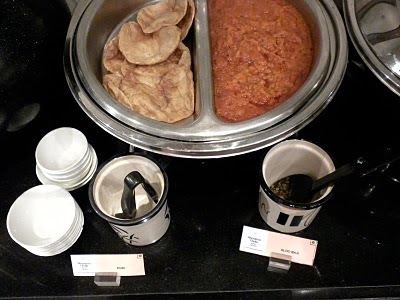
Aloo Bajee and Puri
Curry
The standard flavor for food in India it can mean many things. Curry is at the same time an herb, a spice medley and a type of dish incorporating the spice combo. Curry typically contains other flavors such as coriander (the seed form of cilantro though the Indians call both types coriander) turmeric, cumin, chilies and peppers and all sorts of other spicy stuff. There is green curry, red curry, curry paste, and curry powder depending on what you’re cooking and what country is represented but if I were to be honest I’d say that to my heat-sensitive palate it all tastes the same and it’s all too hot for the flavor to get through. Though feel free to disagree.
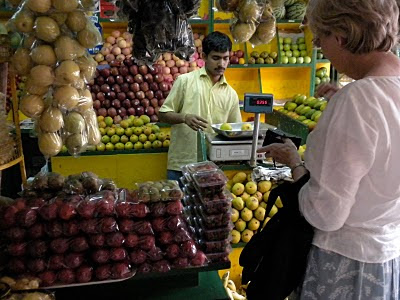
Indian Fruit Stand
Nan (as in "non"-sequitur?--Hey, don't laugh it's all I could think of)
Indian bread that’s baked by flattening out a tortilla-like dough and pressing it to the wall of a clay oven where it cooks much like a tortilla and tastes—surprise, surprise—much like a tortilla. I happen to love tortillas so this got two enthusiastic thumbs up. There are other forms of bread such as puri and roti but none as good as nan and buttered nan is even better. Because calories are what make food taste good.

Ghee (rhymes with me)
The chief oil used in Indian cooking it’s basically a clarified butter in which they fry everything. Seriously. Even their Fruit Loops. It tastes wonderful of course but as you can imagine it’s contributed to the amazing amount of heart disease and general poor health of the population.

Raita (RI-tah)
Yogurt is an import part of Indian cooking and raita is my friend. It’s a yogurt sauce much like tzaziki sauce in Greek cuisine and it’s designed as a fire extinguisher. Spicy food is hot from the oils in the chilies and spices which coat your mouth long after the bite has gone down which is why drinking water is fairly useless in putting out the fire. Instead, bread or dairy products that can absorb the oils are perfect and you’ll see raita sauce as a condiment for cutting the heat and cleansing the palate.

I pretty much dumped it on everything until it was one big raita soup and the result was not unpleasant. In fact I could live quite happily on a diet of nan, dal and raita. With plenty of sweet lime juice.

Biriyani (BEER-ee-yah-nee)
Biriyani is considered a national dish, at least in southern India, and you’ll find it in all forms—chicken, vegetarian, beef or mutton--which actually isn’t mutton at all but goat. Yes, I ate plenty of goat and it wasn’t too bad. They do eat beef here, that’s not taboo as you’d think but there’s a bit of a stigma with eating beef, as if it’s a poor meat though there’s a funny story I heard associated with mutton . . .

At the church there in India where my parents work they had a “curry cookoff” which in itself cracked me up. I’m assuming it’s the Indian equivalent of a chili cookoff and the missionaries working there each entered their own favorite recipes. One of them made a beef curry and when the ladies tasted it they liked it and came back for seconds except that there had been a mistake in the labeling and it instead of labeling it a beef curry it was mislabeled as mutton.

They were going to cross it out and write in beef except that the bishop said that if all the ladies who’d eaten it realized that they’d eaten beef instead of goat they’d all become sick so it remained “mutton curry” and no one realized what the secret ingredient was. What you don't know won't hurt you. . . .

Green Coconut Meat
Lime Juice
One of my favorite things I had was the lime juice. Limes are big in India (though oddly enough they don’t have lemons) and for breakfast I often drank sweet lime juice which was like freshly squeezed orange juice only with limes. Frothy on top, it was completely wonderful and I could drink gallons of the stuff. They sometimes serve it with soda and call it sweet lime soda and I had several of those excellent babies while lounging by the pool in Hyderabad. They also have a salty variety and while it would be easiest to say it tastes like salty lime juice it’s probably more descriptive to say it reminds me of grapefruits because I always eat my grapefruit with salt sprinkled on top. Tasty and different.

Oh, and they also had watermelon juice and something called "mashmelon juice" which were both heavenly. Bring on the mashmelon juice.

Cold things
While ice cream is very popular and you can get it nearly everywhere (though it’s not as good as American ice cream) there’s kind of a superstition that eating or drinking cold things is bad for your health and people will often think that if they eat something cold they’ll catch cold. I suppose it makes about as much sense as we in the west thinking that if you get cold you’ll catch a cold but it means that most drinks and things are served at room temperature unless you ask. And even sometimes then it may not happen. They love to please and instead of disappointing you by saying they don't have something they'll just bring you something else and pretend you asked for it instead.
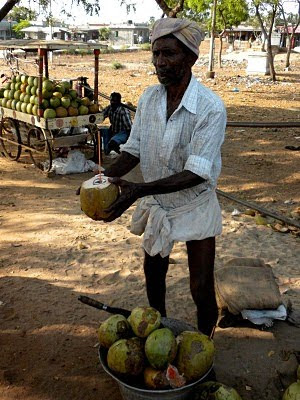
Green Coconut Juice
Green Coconuts
One of the drinks that Indians think is healthful is green coconuts. As in unripe coconuts. You see vendors everywhere with piles of them and they’ll swipe off the top with a machete, stick a straw in it and hand it over. I tried it a couple of times and all I can say is that it must be an acquired taste. You think it’ll be nice and coconutty, with all that good milky flavor coming at you but instead it’s rather bitter and thin and that whole room temperature thing just adds to the ambiance. One time we got them to cut the whole thing in half so we could eat the insides, thinking that the coconut meat had to be better but instead we just got something that reminded me of chilled monkey brains. Without the chilled part. Definitely not a treat.

Green Coconut Juice
Fruits
I thought I’d seen everything the world had to offer when it came to fruits and veggies but boy was I wrong. In the photograph below you see from the top clockwise: sapota, white guava and jack fruit which are completely amazing. They look kind of like a cross between a potato and a watermelon—big like a watermelon but brownish like a potato—and they grow on trees suspended on one end by a little skinny vine. When you cut them open it’s a disaster because they’re full of this goopy stuff that seems like some kind of organic latex--sticky and gloppy. Inside are the little segments you see in the photo and once you’ve cleaned all the gel off you take out the seed from each segment and feast. The taste and texture remind me of dehydrated apple--rubbery and sweet.

Sapota, White Guava and Jack Fruit
The sapota are much like persimmons in texture and very very sweet. I didn't care for it too much and the guava was full of seeds but had a nice flavor. They also have things like dragon fruit and fifteen varieties of mangoes and lots of melons but they also have things like mango flavored ginger root which sounds like heaven to me. When are we going to get some of that?

India Potato Chips
Indian junk food
Potatoes chips are huge in India as well as ketchup. I don’t know why we didn’t think of this first but they married the two flavors to create ketchup flavored potato chips and let me tell you they’re good. It’s kind of like French fries with ketchup built in but they have fancier flavors like Spanish Tomato Tango which can only be described as a party in your mouth.

And yes, that package says "Naughty Tomatoes." Heh.

Breakfast
But the best way to get a handle on India food is to go to a breakfast buffet. Indians don’t have sugary breakfasts like we do in America, they eat a lot of the same things for breakfast that they do for lunch and dinner but the difference is that breakfast food is much milder. Apparently they don’t do spice before noon. Vadas (or wadas as they pronounce it) are little donuts of meal with onions and garlic, idly are steamed dumplings that can have chopped peppers or other treats cooked in and dosas are like big crepes with a potato curry filling (you can see vadas and idly capsicum in the top picture). All come with a rainbow of condiments, curries and chutneys on the side and all are very good. My favorite was probably aloo bajee (picture number two) which is a potato mixture in tomato sauce that comes with a fry bread on the side. Not too spicy and kind of like huevos rancheros. Only without the huevos.

Sponsored by Annette Lyon, whose new novel Band of Sisters is now in print.

Sunday, March 28, 2010

Even Shopping in India Is More Fun

Shopping in India
When Mom and I got to Commercial Street for some shopping Sampath dropped us at one end and we immediately headed into Mysore Silks which is an upper-end store for buying saris and other textiles. Large counters stood in front of shelves filled with every color and pattern of the most beautiful silk. Women sat on stools in front of counters so that the sales clerks (nearly all men) could pull a piece of fabric off the shelf and drape it over the counter for inspection. In other places the sales clerks would stand on platforms that looked like mini cat walks with women on stools in front of them to view each clerk as he would wrap the silk over his shoulder or hold it up to his face to give his customer an idea of what she might look like with the fabric on her own body.

Shopping in India
Piles and piles of silk built up as the women would point to new pieces for examination until there was a mountain of fabric. An extra salesman stood by, his only job being to fold up all the silks when the customer was finished.

I’ve lived in all corners to the United States, in some places customer service is fine and in some places it’s atrocious (*ahem* east coast) but never have I seen a place with more people attentively waiting on you than in India. The salesclerks, hostesses and wait staff are often so helpful they run the risk of smothering you with care. When in Kabini at the Cicada Resort not only would the waiters pull out my chair at dinner but they’d place my napkin on my lap, pour my bottled water then hover by my side, ready to explain each dish and condiment to me as I went through the buffet.

Shopping in India
In fact it’s almost too much. They’re all so nice and attentive that it makes you feel a bit uncomfortable at times. I’m not used to having personal servants whose sole purpose is to serve my every whim and at one point in our shopping experience when we wanted to go down a certain market street our chauffeur refused to let us go alone and insisted on walking ahead to clear the street to keep us safe and I felt awkwardly like some 18th century British memsahib out for a stroll with her servants and it didn’t suit me.

But all that customer service comes at a price. I asked if the caste system had really been abolished and was told that while it technically has been outlawed and things aren’t what they used to be it still functions at many levels. Not only do people marry almost exclusively within their castes but last names and skin tones are status indicators. The paradox is that while castes are illegal there are government affirmative action programs for lowest caste members and people of all stations will still give deference to those of higher castes. Europeans and westerners are typically considered outside the caste system and are given added consideration beyond what the Indians themselves could expect.

In fact, it’s quite disturbing to see but light skin tones are universally admired and given preference—every billboard, every television ad, every movie had light skinned models and every other commercial is an ad for skin lightening products. If you judged India by its media and advertisements you’d think that every one of her 1.3 billion people is merely a misplaced European who happens to speak Hindi or Tamil or Telagu.

I met hundreds of Indians during our two weeks. Wonderful, handsome people from all walks and social strata with beautiful features and skin and not once did I meet anyone who looked like the five-story faces I saw glaring at me from the billboards. What a pity that the beauty and culture of the real face of India is being ignored in favor of a westernized version held up as a false ideal. Neither India nor the west needs that kind of stereotype reinforcement.

But within the caste system is the added issue of gender. And strange as it may feel to those of us used to the west, while customer service is stellar, men in India are usually treated with more respect. Bell hops and porters are eager to take your bags but they will often take a man’s bag but not a woman’s, leaving her to trail behind with her own luggage. I noticed at restaurants that servants would rush to seat Andrew or to open his door but would ignore me. Not every time but often enough for me to notice and Andrew would end up compensating by telling staff to help me first. So there’s excellent service but with an asterisk. A big asterisk. There’s no reason or use to get upset about it, it’s just a fact of life in India and one that will probably change as culture shifts.

Shopping in India
But meanwhile, back at the sari shop . . . after watching the women buy their silks we continued wandering down Commercial Street, seeing something new and unusual on every corner and in every alley. We stopped in at a little antique shop with dusty brass bells and marble elephants, clocks from Victoria Station and hand blown glass lamps which was so narrow and stuffed with curiosities that when the two other people in the shop wanted to get out we had to leave the shop ourselves to let them pass.

Then farther down the street we came upon an even odder site. Pardon my staring, but at one point I saw a “nine” or an Indian transvestite. A tall man in a coffee brown sparkling sari, earrings, gold bangles and heavy eye makeup, he passed just as I registered what I was seeing.

I’d heard about nines before so Mom gave me a dig in the ribs as we passed to clue me in. She says nines will often travel in groups, begging at intersections and Sampath says they’re not allowed to work so he gives them money. It was unclear why they weren’t allowed to work but they’ll live together in little communes around the city, coming out in groups of three to five for amazed tourists such as myself.

So about the time I was wishing that I were bold enough to pull out my camera and snap a picture of the Indian transvestite we walked past a shoe store. Many stores have basements with flights of stairs leading up to the street almost as if they are built in an underground parking garage that’s been turned into a store and we walked down a short flight of steps from the street into the store.

There, trying on gold high-heeled sandals with large faux gems sparkling on the toes, were two women in full burkas. They were lifting their skirts slightly and admiring their feet in the mirror and had several boxes of silver, gold and white jeweled shoes lying open around them and while I couldn’t see their faces I knew exactly what they were doing. Apparently shoe shopping is an activity that knows no cultural boundaries.

I smiled at them and pointed to the gold pair, indicating that that was the best choice and the one I would get and their eyes crinkled at the corners in reciprocal smiles. The shop was run by Muslims and as a little man in a white crocheted skull cap ran forward to sell me shoes I noticed a teenage Hindu boy limping toward me. He was carrying a stack of shoe boxes high enough that I could barely see his face and his left leg, which was twisted ninety degrees, he dragged behind him.

It took me about fifteen seconds to find out from the salesman that the largest size they had wasn’t big enough to fit me—no surprise there—and as we turned to leave I noticed yet another employee. A Muslim, but an older man who was also a dwarf.

Back on the street I asked Mom, “Did you see all that?”

“What?” she said.

“Two women in burkas trying on sparkling sandals, a Hindu with a bad leg and a Muslim dwarf.”

We looked at each other and shrugged because it was just one more of the many interesting things that you see in India every day and Mom said, “You know, it kind of sounds like the set up of a joke. ‘ Two Americans walk into a shoe store and there are two women in burkas, a crippled Hindu and a Muslim dwarf.’ Now all we need is the punch line.”

We started laughing at the strangeness of it all and chuckled half way down the alley way. I’d love to have the shop owner’s view of us—I’m sure we seemed just as strange and interesting to them as they did to us.

Sponsored by Sorella Jewelry Studio for fine personalized jewelry.

Saturday, March 27, 2010

The Silk Worm Auction

Mysore Silk Worm Auction
I'm sure most of you are aware where silk comes from. Most school children learn how the little silk worm eats the mulberry leaves then spins his cocoon and we miraculously have silk. But while we were on the road to Mysore we stopped by the place where the silk worm cocoons are bought and traded and it was the most fascinating place--possibly the most fascinating so far.

Mysore Silk Worm Auction
We walked into the open warehouse to see tables lining the rooms, some empty, some full as the farmers arrived to bring their goods for sale. The men arrived carrying bags four or five times as large as a rolled sleeping bag, full of what looked like packing peanuts until they spilled them out into the bins for display.

Mysore Silk Worm Auction
We made our way around the room with Sampath as our interpreter (he spoke the native Kannada) and the men began gathering around us until we had an enormous crowd following us through the room. Soon they were all around us, asking Sampath questions which he'd interpret for us. Questions like how much a pound of chicken or a pound of rice cost in America or what our wedding rings were for and it was fun to see that they were as interested in us as we were in them. They were completely blown away by the prices and I got the feeling they were laughing at the stupid Americans who would dare pay $12/pound for a piece of fish.

Mysore Silk Worm Auction
You can see how we attracted stares--or more accurately how I attracted stares. I think it was because I'm so tall and pale but they were very open about staring at me where ever I went. As we talked with the group of men you see in the top picture (Sampath is the third one from the left) one very small old man with a turban took special interest and wanted me to scoop up the cocoons in my hand to feel them then gave me some to keep. I wish I could have got a picture but while most of the men loved having us take their picture he was too shy and said no. This picture is a different man but I thought he looked great nonetheless.

Mysore Silk Worm Auction
Each cocoon has a tiny live worm inside which in ten more days will emerge as a butterfly and if you rattle it you can hear the little guy rattling around in there. Each table you see has enough cocoons to equal roughly $100, the Indian variety sells for about 250 rupees per kilo and the Chinese variety which are whiter and have more silk are about 270 rupees per kilo. When the cocoons are sold they will be thrown into the water where the silk will soften and they get about 800-1000 meters of silk for each cocoon for the Indian ones.

Mysore Silk Worm Auction
It sure makes me appreciate silk more now that I know how the process works.

Sponsored by Polkadot Peacock for children's bedding.

Friday, March 26, 2010

I Promised You Tigers Didn't I?

Safari at Kabini
The Cicada Resort sits on the edge of Rajiv Gandhi National Park. If you'll forgive a tiny history lesson, Rajiv Gandhi was the grandson of Jawarhalal Nehru (India's first prime minister) and the son of Indira Gandhi (India's first and only female prime minister who was assassinated in 1984 if memory serves). Born into such a prestigious family it was natural that he should take over as India's youngest prime minister after his mother's death but was himself assassinated by a suicide bomber in 1991 just outside of Chennai where a monument now stands to his memory.

Safari at Kabini
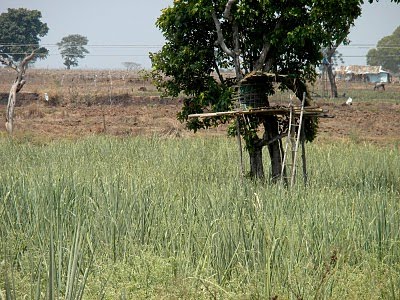
Approaching the park named in his honor you pass villages and fields full of sugar cane and rows of red earth ready for planting before the rains come but every once in a while you see little tree houses perched above the green plain. However these tree houses aren't for children. They're to protect the villagers from the most dangerous animal in the forest.

Safari at Kabini
It's not the tiger. Elephants cause more damage and more deaths than tigers and after a trip through the forest I can understand why. We'd seen dozens of elephants at the river but not until that day did I understand why the villagers took so many precautions. They may not have teeth or claws but they are wild animals that are unpredictable and their size makes them a danger regardless of their diet.

Safari at Kabini
We boarded the truck early Tuesday morning for our safari into the park with blankets over our laps to protect against the morning chill and full of eager anticipation to see tigers and leopards and any other carnivores India had to offer.

Safari at Kabini
There were deer nibbling grass, kingfishers, bison, monkeys leaping from tree to tree, mongooses (mongeese?) stalking snakes, strange-looking squirrels far above our heads and boars rooting for food in the brush.

Safari at Kabini
But we hadn't seen any tigers and that's what we'd come for. We stopped at a half-way point at a crossroads in the forest then headed deeper along the dangerously rutted and muddy road that twisted and turned up and down hills until I was sure the truck would give out. At one point after a particularly nasty smashing bump there was an odd rattling sound coming from under the chassis. The driver stopped, climbed down under the truck with a fresh piece of rope in his hand, disappeared for a moment, then emerged with a shredded piece of old rope. Apparently whatever had fallen down was now retied and was good as new. Whatever "new" might be. It didn't make me feel particularly confident that we'd make it back without destroying the car and I wondered what my chances of making my way home through tiger-infested forests might be.


Past the twists and turns the road leveled out to where clumps of bamboo stood towering along the slopes leading down to the river bank. The motor shut off as the guide stopped to listen to the birds, noting their position and calls and what it meant about where the tigers might be.


Only the day before we'd waited offshore in our boat and I'd watched those same clumps of bamboo from the water and though the birds sang and the waves lapped it suddenly became strangely quiet around me as the bamboo began to creak. The sounds grew louder until the creaking changed to the sound of breaking wood and groaning stalks and I watched the shifting clumps in front of me with a strange feeling of horror even though I was safely offshore.


The wind picked up and blew ominously and the groaning and creaking increased as it moved along towards me. Louder and louder until it was right in front of me then it continued on along the river as the elephants moved on, the sound dying away as they passed unseen behind the bamboo, tramping and foraging. It's hard to describe my excitement at hearing them approach--the scope of their strength suddenly becoming a reality--and then my nervousness as we sat there in the truck at nearly the same point the next day but without the safety of distance.


While I sat there in the forest quietly remembering the experience and wondering if an elephant was going to burst out of the brush at any moment and charge the truck, our guide continued listening to the birds and after a moment he whispered, "There is most certainly a tiger there," as he gestured to the brush along the path.

There were no sounds of peacocks now as we listened to what our guide was hearing and tried to pick up the signals ourselves. A troupe of monkeys played in the trees on the other side of the truck and a few spotted deer grazed on the grass in patches of sunlight as we waited and everything seemed so peaceful and orderly. Minutes went by and we said nothing but our guide continued to fix his stare into the brush fifty feet off, narrowing his eyes and resting his hand over his mouth as he waited.

I stared at the monkeys off to the other side, starting to think that it all had been a mistake, when in one great collective movement they scattered. At the same time the deer raised their heads and bounded into the brush as birds called off in the distance and monkeys chattered angrily.

Our guide stood up and immediately looked in the opposite direct from where the animals had run, pointing and saying, "Tiger! Tiger!"

It took us a second to understand where he was pointing and what he meant, it all happened so quickly, but then we saw it too. The cat coming out of the brush, it's stripes much lighter than I'd expected with the morning sun hitting them across his back, but with the unmistakable movement and sleekness you'd expect. It really was a tiger and before we could raise our cameras or communicate what we were seeing he turned into the bushes and disappeared.

A tiger in the wild. And I saw it right there as it stalked it prey.

Sponsored by Dimples and Dandelions

Thursday, March 25, 2010

Safari on the Kabini River

Monkeys on the Kabini River
While we were on safari this week I stopped several times and mentally stood apart from the scene I was in and wondered how it had come to be that I was there. Life travels along so fast, with details flying past me as I go from one day to the next then suddenly I'm on the other side of the world, trailing my hand in the Kabini River, squinting as the sun dips farther toward the horizon and listening to the peacocks call to each other from the shore while the wild boars drink at the water's edge. I hope everyone has at least one day in their life like that, a day that stands apart from all other days forever after.

The Cicada Resort on the Kabini River
Monday morning we left Bangalore and drove southeast toward the state of Kerala and Kabini, a river that runs from coast to coast across the southern tip of the subcontinent, widening into a dragon-shaped reservoir on the west where the water has been dammed. There are a couple very small resorts there (very small) and we stayed at the newly remodeled Cicada Resort and it was as romantic and thrilling as anything you'd imagine. I did try to capture a picture of our room (including our super cool shower) on video here.

Relaxing at the Cicada Resort
When we got there we sipped coconut milk by the pool until they brought our bags to the bungalow-style rooms on the riverbank then Andrew and I killed an hour in the pool before heading for the river safari. I guess you could say it was like the real-life version of the Disney Jungle Ride only without the dumb jokes and mechanical head hunters dancing in a circle.

Safari at Kabini
Our guide--who looked remarkably like an Indian hybrid of Harrison Ford and Richard Gere--took us out on the river that afternoon where we motored down stream passing crocodiles, deer, wild boar, elephants, stork, eagles and deer.

Safari on the Kabini River
There are three kinds of deer along the river: spotted deer, sambar deer and barking deer who in fact do make a strange barking sound when they're startled, and plenty of monkeys and peacocks. We're finishing up the dry season just before the monsoons hit so March and April are the best months to see wildlife because the animals are more likely to come to drink.

The Kabini River
Even watching people along the river was fascinating. Men with hand-tossed fishing nets that splayed out over the waves before dropping into the water near the shore, women carrying loads of wash on their heads, children playing alongside their parents and people crossing back and forth in coracle boats which are round dish-shaped vessels like you see above. They hardly look seaworthy--you can see how low in the water they ride--and I can't imagine how one would steer but they are lightweight and beautiful and seem to do the trick. Just try not to think about the crocodiles.

The Kabini River
When we returned the sun was a hazy orange circle in the sky and as we stepped off the dock I saw a crazy sight. We'd noticed little black frogs when we'd boarded but now that the sun was setting more frogs had gathered around the dock until there were so many it was like one of the plagues of Egypt--and I've got video to prove it. It was hard to step without smashing them and just one more little part to the beauty of the afternoon.

Safari on the Kabini River
If you stick around I'll tell you about the tiger. . . .

Sponsored by Beau-Coup for unique baby shower favors.

Wednesday, March 24, 2010

Lost in Translation

Indian Traffic
"Highly Inflammable"??

We had a good laugh with this one and every tanker has it written on the back.

Apparently it's a challenge. Just try and ignite this stuff, we dare you.

English is spoken throughout India and you'll see signs in both the local native language--in Bangalore and the state of Karnataka it's Kannada--and English but often the words are slightly off. Not necessarily wrong, mind you, just off from what you'd see in the U.S., Canada or the UK.

For example, we were in a restaurant last night and a sign said, "Selling of milk will not happen."

Uh . . . what? I think it means they don't sell milk, not that the practice has stopped throughout the nation but it made me giggle.

Often they'll use strange combinations such as "very less." As in "It's very less hot today." Or superlatives such as "fully" as in: "The glass is fully empty." "I have a doubt" means simply, "I have a question."

Then there are funny adjectives or nouns they'll pick up and use which are legitimate English words but not ones that you'd ever hear anyone on this side of the globe speak such as "dissonance" or "sanguine." As in: "We apologize for the dissonance and hope you are sanguine with the construction." Heh. Americans would need a dictionary to know what they're talking about.

Cousins are "far brothers" (which I absolutely love), home town is "native place," restaurant is "hotel," detours are "diversions" and moving is "shifting."

The whole thing brings out an interesting question, namely, what makes a language "correct"? Americans speak to each other and we know exactly what is correct and what is incorrect here in the states--or at least what is formal and what is colloquial. But here you have a nation that has 400 times more English speakers than America and who is to say that how we do it is right? There are millions and millions of Indian school children growing up speaking Indian English and by a simple majority their way could be argued to be more correct than my own dialect.

Does antiquity make a language legitimate? Because if that's the case we lose with that argument as well. The UK and many other parts of the world beat us there and Indian English started about the same time of American independence so we really can't be too sure that our way has the weight of age behind it and that these other countries are merely the new kids on the block.

Anyway, it's just interesting to think about because if numbers mean anything there will soon be many more speakers saying "What is your good name?" instead of "What is your full name?" and the rest of us may find ourselves picking up some of their speech for a change. Could be fun, no?

Sponsored by Annette Lyon, whose new novel Band of Sisters is now in print.

Tuesday, March 23, 2010

A Visit to Sampath's Native Place

Sampath's Mother and Village
I'm embarrassed to admit it but if you'd asked me last month what rural life in India was like I probably would have resurrected a mental picture straight from Indiana Jones and the Temple of Doom. Starving villagers, emaciated children, dry and dusty landscapes with hovels scattered here and there.

Sampath's Village
Which is why I was so curious (and rather nervous) to see Sampath's village. He's my parents' driver and while he lives in Bangalore his "native place" (as the Indians say) is the village of Yaramanaguntulu, an hour and a half outside the city where he goes whenever he can. After driving to the coast on Friday and spending the night in Chennai we headed back to Bangalore on Saturday, taking a slight detour so we could visit Yaramanaguntulu and meet his family. It took me about eighteen times of having Sampath repeat the name before I could say it properly.

chritamm@email.com
It really was an honor, my parents think so much of Sampath so to be able to finally meet his family was a treat and I was thrilled that it happened while we were there and it was nothing like my silly Hollywood misconceptions.

chritamm@email.com
While the city can be dirty--trash pretty much everywhere--and the road to Pondicherry was in places lined with sad little huts as a picture of poverty, the village was completely beautiful. Imagine a small town in America with farmhouses and fields of crops stretching out to the horizon past the back porch and cows grazing in the shade; a few dogs here and there and maybe the corn half-way grown. Now pretend it's in India.

chritamm@email.com
The houses were small and many were made of local red bricks covered in plaster then painted in glorious blues and greens and pinks with thatched roofs but the similarities of rural life in India and rural life in America were more than the differences. Sampath has about eight acres where they have mango trees, chili fields and a certain fruit whose name suddenly escapes me.

chritamm@email.com
The yards were clean and the porches swept where chili peppers and tamarind pods were drying in the sun after the recent harvest. They've had a drought for the last two years--the monsoons haven't been as generous--and while water is scarce and drinking water is trucked in by the government the family has a 600 foot well that is powered by the government for their irrigation and household use.

chritamm@email.com
It felt homey and comfortable with the smell of agriculture and livestock blowing around me on the gentle breeze and the chickens peeking out of the shade to go and scratch for a meal and my Dad kept saying how he now understood why Sampath wanted to leave city life and go back to the country to stay on his farm with his children.

Here's a picture of my mom and me with some of his female relations, we're--uh--the ones in the middle. On the way back to the main road we passed a tiny store where some of his friends and family were gathered and when we passed by the woman on the far right came out to meet us. Her daughter, the one in purple on the far left, was nervous but her mother kept smiling and insisting she come forward to shake hands. The woman next to my mother kept gesturing to us and letting us know that she thought we were enormously tall.

chritamm@email.com
While the country life looked idyllic and quaint with all the charms you'd want from the Indian version of the Heartland it also brought us to see the grim reality of Indian life: death. I was told that only very recently has the life expectancy been raised to 60 and while children and teenagers often look much younger than their true ages once adulthood hits you can see how the differences in nutrition and health care have taken their toll.

chritamm@email.com
Sampath is younger than I am but his health is much worse and his mother, who couldn't have been 70, looked nearly one hundred. She was so kind and sweet and welcoming to us but you could see how life had taken away her years and her teeth and her children. When she approached us at first to take our hands in hers in greeting her eyes were red and teary. Sampath's brother who was mentally disabled had developed what they now think must have been stomach cancer but because of the lack of health care and his disabilities they didn't realize it until it was too late and he died two weeks ago. The poor woman was obviously still in mourning for her son and I couldn't help think of all I take for granted.

Sampath says that to live in Bangalore it costs about 10,000 rupees per month (lower middle class) but in his village he can be comfortable on 1,000. Right now there are approximately 50 rupees to the dollar which translates into roughly $200 and $20. No wonder he'd like to go back--but the city has the wages so he stays to work until he has enough to retire and build a house for himself behind his mother's home and stay in the shade sipping mango juice and looking out over his orchards for the rest of his years.

Sounds pretty good to me.

Sponsored by Sorella Jewelry Studio for fine personalized jewelry.